
Separate the studio stream from the betting experience
 Available in US
A practical look at live-dealer mechanics, online trade-offs, demo play, licensing searches and bonus terms.
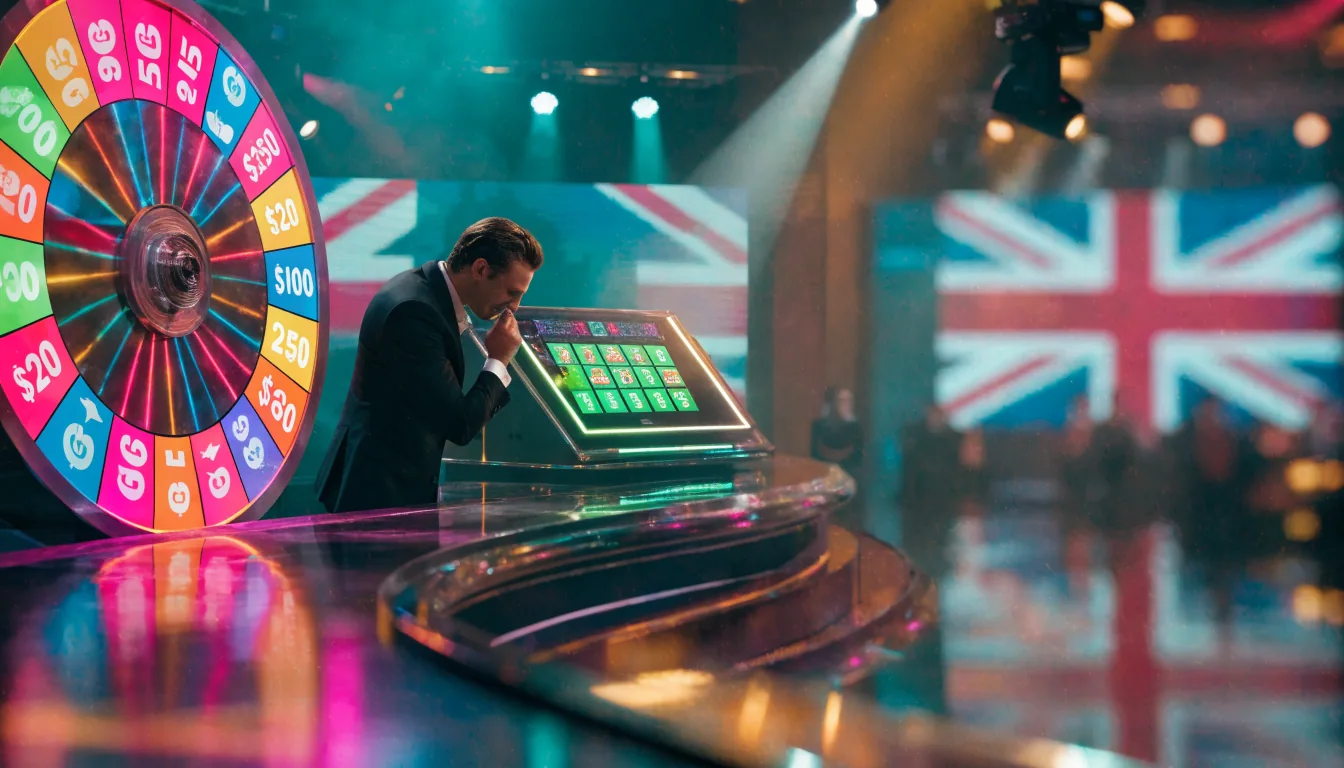
How Crazy Time Fits the Live-Casino Format
Crazy Time is searched for as a live casino game show, but the useful starting point is the format rather than the label. A live dealer game combines a real-time studio stream with a human dealer and an on-screen betting interface. The stream shows the game taking place; the interface is where players make and submit their bets. Those are separate parts of one experience.
That distinction matters. The dealer is not simply an animation placed over a digital game. Live dealer play is broadcast from a studio, with a person presenting the game in real time. The player’s view comes through the stream, while the betting controls appear on screen alongside it. The action is therefore both physical and digital: a studio event is shown online, and decisions are entered through software.
I have seen how easily those two layers get blurred in casino copy. A page may call a title “live” and leave the impression that every part of the experience happens in the same way as a visit to a casino floor. It does not. The stream carries the dealer and the game as they happen; the interface carries the player’s choices. The format depends on both.
For someone looking at Crazy Time in the UK, that gives a grounded way to understand what “live casino” means. It describes the delivery method: a studio feed with a human dealer, paired with a digital screen through which bets are placed. It does not, on its own, describe every rule, round or visual element of a particular title. The game name and the live format answer different questions.
That difference is commercially important. “Live” can sound like a complete description, when it is really a description of how play is presented. A streamed dealer does not make every feature self-explanatory, and a screen full of controls does not tell the whole story of what is happening in the studio. The practical point is simpler: the viewer watches a real-time game and uses the interface to participate by placing bets.

In a conventional digital casino game, the presentation and game outcome are generated on screen. In live dealer play, the visible setting is a studio and a human dealer is part of the broadcast. That is the central contrast, without needing to assume that every live title works identically. A title may have its own rules and layout; the shared live-casino framework is the stream, dealer and betting interface.
This is why the phrase “game show” should not be treated as a substitute for a rules explanation. It may describe the way a title is presented or branded, but the general live-casino format only establishes that play is streamed from a studio and bets are submitted through an on-screen interface. Specific mechanics have to be understood from the individual game’s own presentation and rules, not inferred from the format label.
The interface is not incidental. It connects the person watching the stream to the game’s betting process. A player does not place a bet by speaking to the dealer or handling equipment in the studio; the interaction described by the format takes place through the on-screen controls. The stream and controls work together, but they do different jobs. One shows the live action; the other records the player’s choices.
From an industry perspective, that division is the part worth keeping in view. The studio provides the visible, human-led event. The software provides the route for submitting bets. Calling the result a live casino experience is accurate, but it does not mean that the player is physically present or that every element is handled by the dealer. It is a broadcast joined to an online interface.
So Crazy Time live casino play sits within a recognisable model of online gambling: real-time studio gameplay, a human dealer on the stream, and bets made through the screen. That is enough to explain the format without dressing it up as a promise about the title itself. The label sets the scene. The rules explain the game.
Playing Online: The Practical Trade-Offs
The appeal of a live casino game is also the source of its practical limits. Unlike a digital version that can move from one result to the next quickly, live play proceeds at a slower pace. A player may have to wait through the table’s sequence before another decision can be made. That changes the feel of a session: there is more time between bets, but less control over how quickly the game advances.
I have seen that distinction matter more than the visual presentation. A game can look lively on screen and still have a measured rhythm. The stream follows the live table rather than speeding up to match an individual player’s preferred pace. In a search for Crazy Time online casino play, it is easy to focus on the name and overlook this basic condition: the experience belongs to a live format, with the timing that comes with it.
That slower rhythm is not a defect. It is a trade-off. Some players value the sense of a shared, unfolding event; others prefer the immediacy of a digital game. Neither preference changes the pace of the live table. The game continues on its own schedule.
A slower session
In practical terms, live play leaves less room for rapid repetition. The gap between decisions can make a session feel less intense, but it can also make time pass differently from what a player expects. A short stretch of waiting may seem inconsequential; repeated across a session, it becomes part of the experience.
This matters when setting a budget. A slower game does not make gambling safer or guarantee a more favourable result. It only changes the tempo. I have found that treating the pace as entertainment, rather than as a reason to extend a session, is the more grounded way to approach it. Set a spending limit before play and keep to it; waiting for the next round is not a reason to add funds or pursue losses.

The same point applies to expectations about control. The interface may make placing a bet straightforward, but it does not give a player control over the table’s timing. There is no useful shortcut around the live sequence. A decision has to fit the available betting window, then the game moves on.
Minimum stakes change the calculation
Live games also tend to have higher minimum bets than digital versions. That difference can make a session less flexible for someone who wants to keep each stake small. A minimum is not merely a suggested starting point: it defines the lowest permitted bet at that table. If that floor is above a planned stake, the table may not fit the player’s budget.
This is one reason the phrase “low stakes” needs care in casino advertising. It can describe a relative position, not a universal price. A live table and a digital game can have different minimums, and limits can vary between tables. The relevant question is whether the minimum shown in the interface is compatible with a pre-set budget—not whether a game is presented as accessible.
I would not treat a higher minimum as a signal that a game offers better value. It is a condition of entry, not evidence about likely outcomes. Nor does a longer wait between decisions offset a larger stake. Those are separate features, and combining them into a promise of a more manageable session would be misleading.
Connection is part of the experience
A stable internet connection is necessary for live play. If the stream is interrupted or delayed, the experience can become difficult to follow, particularly when a decision has to be made within the game’s available window. Connection quality is therefore not a minor technical detail; it affects whether the live format can be used as intended.
A stable connection does not determine a result, and it cannot make a table move faster. It supports continuity: the stream and the on-screen controls need to remain usable together. That is the practical distinction between being able to open a casino page and being able to take part comfortably in a live session.
I have seen people judge the game itself when the real frustration is the surrounding setup. A choppy stream can make a measured pace feel slower still, while a delay can leave uncertainty about what is happening on screen. Those are experience problems, not signs that the game’s outcome can be predicted or influenced.
For anyone considering Crazy Time casino play online, these conditions are more useful to understand than a broad claim that live play is “immersive” or “easy”. The format asks for patience, a stake that fits the table minimum and a connection stable enough to follow the session. If any one of those conditions does not suit the circumstances, the game may be a poor fit at that moment. No drama.
Casino Sites and the Limits of What Can Be Verified
A search for Crazy Time casino sites can turn up confident claims about availability, but a claim is not the same as a checked fact. I would not name a particular operator as offering the game without being able to confirm that listing directly. The same applies to claims about which UK casinos carry it: a general live-casino page does not establish that a specific title is available.
That distinction matters because casino catalogues change. A game may appear in a promotional page, an old review or a third-party directory after the operator’s own offering has changed. Even a listing on an operator’s site can require checking in context: the relevant game must be available to the intended market, not merely mentioned somewhere in the catalogue. Without that confirmation, an operator list would look more certain than it is.
The dependable point is narrower. Live dealer casinos serving the UK are legal when they hold a licence from the UK Gambling Commission. That establishes the regulatory condition for operating in the market; it does not confirm that a particular licensed casino offers Crazy Time. A licence and a game listing answer different questions.

I have seen those two checks blurred in casino copy. A page may present a licensed operator beside a game name, leaving the impression that the licence verifies the game’s presence. It does not. The operator’s regulatory status is one matter; the current contents of its live-casino lobby are another. Keeping them separate is basic due diligence, not a technicality.
For anyone assessing a claim about Crazy Time casino sites in the UK, the useful evidence is a current listing from the operator itself, with the game identifiable in the relevant lobby. If the listing cannot be confirmed, the honest wording is that availability is unverified. That is less persuasive than a ranked directory, but more accurate.
The same restraint applies to the phrase “best Crazy Time casino sites”. A site cannot be called the best for this game merely because it has a UKGC licence, nor can a general casino ranking establish that the game is currently offered. A comparison needs confirmed availability first. Without it, the ranking is decoration.
Searches for Crazy Time casino bonuses, scores or strategies can also create expectations that a site list will answer several different questions at once. It will not. A casino’s game catalogue does not establish a particular bonus condition, provide a reliable record of game scores, or demonstrate a way to improve results. Those are separate claims and require separate evidence. Nothing about an operator’s licence turns them into verified statements.
“Exclusive” is another word I treat cautiously. In promotional material it can mean a genuine arrangement, but it can also be a label applied to an ordinary listing or offer. The word alone proves neither that a game is available nor that an offer applies to it. Plain evidence beats the label.
This is not an argument that no UK casino offers Crazy Time. It is a limit on what can be stated responsibly without a confirmed, current operator listing. Naming sites anyway would turn uncertainty into a recommendation. Better to leave the list empty than imply verification that has not been made.
Where the Live-Game Experience Comes From
A live casino game combines two things that are easy to mistake for one. The game action takes place in a studio, where a human dealer conducts it in real time; the player’s decisions are made through an on-screen interface. The screen is therefore not simply displaying a digital game with a dealer-themed background. It carries a live event and a separate layer through which bets are placed.

That distinction matters when considering what it means to play Crazy Time live. The title may bring to mind a particular wheel or show format, but the general live-casino model alone does not establish the details of its rounds, equipment or rules. What can be said about the format is narrower: a studio provides the real-time gameplay, while the interface connects the player’s betting choices to that event. The production and the control panel are parts of one experience, but they are not the same thing.
In a purely digital casino game, the action is generated by software rather than streamed from a studio with a human dealer. The display may still be polished and animated, but visual realism does not make it a live broadcast. In live play, the human dealer is present in the streamed game itself. That is the defining difference—not a promise that the game is more favourable, more transparent in every respect or more entertaining for every player.
From an industry perspective, the interface has a practical job: it turns the activity taking place in the studio into choices a remote player can make on screen. A player does not place a bet by speaking to the dealer or handling the studio equipment. The interaction runs through the betting controls, while the dealer remains part of the live presentation. That division is worth keeping in mind when promotional language calls a game “immersive”. The word describes an impression, not a different way of placing bets.
The same distinction helps separate a live wheel game from a digital wheel game without assuming that every game with a wheel is built alike. A wheel shown on screen could belong to a studio stream or to software-generated gameplay; the appearance alone does not settle which. For Crazy Time, the live-casino label points to the studio-and-interface model, but it should not be stretched into claims about unconfirmed features.
So the experience comes from a real-time studio feed combined with remote betting controls. The dealer supplies the live element; the interface supplies the means to participate. Two layers, one game.
What “Best” Can Mean Without a Verified Shortlist
When exploring Crazy Time live casino options in the UK for 2026, payout timing is one practical detail to check. This list highlights the payout speed stated for each operator.
-
Dieselwin
- Payout speed
- 1-3 business days
Dieselwin lists a payout speed of 1–3 business days.
-
Chanze
- Payout speed
- 1-3 business days
Chanze lists a payout speed of 1–3 business days.
-
EvoSpin
- Payout speed
- 1-3 business days
EvoSpin lists a payout speed of 1–3 business days.
-
SpinFormula
- Payout speed
- 1-3 business days
SpinFormula lists a payout speed of 1–3 business days.
-
Jetsetspins
- Payout speed
- 1-3 business days
Jetsetspins lists a payout speed of 1–3 business days.
-
x3bet
- Payout speed
- 1-3 business days
x3bet lists a payout speed of 1–3 business days.
-
Britsino
- Payout speed
- 1-3 business days
Britsino lists a payout speed of 1–3 business days.
-
Revery Play
- Payout speed
- 1-3 business days
Revery Play lists a payout speed of 1–3 business days.
-
Amunbet
- Payout speed
- 1-3 business days
Amunbet lists a payout speed of 1–3 business days.
-
Zombillion
- Payout speed
- 1-3 business days
Zombillion lists a payout speed of 1–3 business days.
“Best” is a comparison, not a property that can be attached to a casino without saying what is being compared. For a UK player looking for Crazy Time, a useful assessment would need to distinguish the game experience from the operator hosting it. A familiar name or a polished promotion does not, by itself, show that one casino is a better fit.
The practical comparison starts with conditions that can affect a live session. Live games move more slowly than digital games, so the pace may suit someone who prefers time between decisions, but frustrate someone expecting rapid rounds. Minimum bets matter too: a table’s starting stake determines whether the format fits a chosen budget. Connection quality is another basic consideration; a live stream depends on stable internet, and interruptions can make the experience less usable.
Those are meaningful criteria, but they do not create a defensible ranking of the best Crazy Time casinos. A ranking needs comparable, current information about the relevant tables and their terms. Without it, naming a winner would turn an impression into a recommendation. I have seen how easily a “best” label becomes a shortcut for a commercial preference rather than a measured comparison. Fine print gets lost.
The same caution applies to searches for the best strategies for the Crazy Time casino game. A strategy claim needs evidence about the game’s rules and outcomes; a slogan about timing or a pattern spotted in recent results is not enough. Past Crazy Time results do not establish what will happen next, and a record of previous outcomes cannot make a future result predictable. There is no sound basis here for presenting a betting system as an edge.

Nor does the phrase “Crazy Time slot” settle what kind of product is being discussed. A label used in casual conversation is not a substitute for the game’s actual rules or format. The relevant comparison is between the live experience and the conditions around it, not between an assumed slot category and other games.
A careful review would separate observable points—pace, minimum stake and the need for a stable connection—from claims that require stronger evidence. It would also avoid treating a casino result as proof of quality: one outcome says nothing reliable about the operator or future play. “Best” can still be useful, but only when the criteria are stated and the evidence supports them.
I would judge any comparison against the same practical questions, rather than a headline ranking: does the table’s pace suit the session, is its minimum stake acceptable, and can the connection support live play? Those are limits and preferences, not a promise of better results. This is entertainment, not gambling advice.
A Review of the Format, Not a Winning System
A useful review separates what can be said about live casino games in general from what is established about Crazy Time itself. Without substantiated game-specific details, there is no sound basis for presenting a Crazy Time betting strategy as tested, describing a casino history as fact, or treating a tracker as a route to more reliable results. Confident wording does not fill that gap.
Do
- Describe known game rules
- Distinguish observation from prediction
- Treat betting plans as staking plans
Don't
- Present staking sequences as a way to control outcomes
- Use a tracker to predict future results
- Borrow mechanics from other games
The distinction matters because a system can sound analytical while doing little more than organise bets. Tracking past outcomes may produce a record, but a record is not proof that future results can be predicted. Nor does a chart, pattern or staking sequence turn uncertain results into a dependable method. The label “strategy” can make a betting plan sound more effective than the evidence warrants. It remains a plan for staking.
Other live games provide clear examples of what a grounded review can cover, without implying that their rules apply to Crazy Time.
Example: live roulette. A live dealer spins a physical wheel; a computerised version uses a Random Number Generator. The ball settles on a number, and a bet on that number wins if it matches. Those are mechanics a review can explain. They do not establish a method for predicting the next result. A tracker can record what has happened, but recording outcomes is not the same as changing what comes next.
Example: live blackjack. The aim is to beat the dealer with a hand that reaches 21 points without going over. That objective is specific enough to explain the game, but it does not make every betting system sound. Blackjack still carries a house edge, and Martingale-style staking can lead to losses. Raising stakes after losing does not remove the underlying risk; it can increase the amount exposed.
That is the line I use when reviewing live formats: describe the rules that are known, distinguish observation from prediction, and avoid presenting a staking sequence as a way to control outcomes. A review of Crazy Time should not borrow roulette or blackjack mechanics to make its account seem more detailed. Different game, different rules.
The same standard applies to claims about the game’s past. A timeline, origin story or account of how its features changed needs reliable support specific to Crazy Time. Without that, it is better not to dress speculation up as casino history. The same goes for tracker tools: their presence or presentation alone cannot establish that they improve decisions or forecasting.
So a careful review can assess the limits of a proposed strategy and the quality of claims made about tracking, while keeping unsupported details out. It should not promise an edge or imply that past records settle future outcomes. No system removes uncertainty.
Demo Play: What It Can and Cannot Show
A Crazy Time casino demo, if offered, is best treated as a way to become familiar with the presentation, not as evidence of how a real-money session will feel in every respect. The important qualification is “if offered”: a demo should not be assumed to exist at a particular casino or in a particular form.
Where a free-play version is available, it may help show how the game is displayed and how its on-screen controls are arranged. In a live format, the underlying model involves a studio stream, a human dealer and bets entered through an interface. Seeing those elements together can make the format less unfamiliar before deciding whether it suits a player. It does not establish that every detail, option or screen in a real-money version will be identical.
That distinction matters. In my experience, promotional wording such as “try before you play” can sound like a close rehearsal. It is more limited than that. A demo can offer orientation; it cannot certify the experience at every operator, and it cannot stand in for reviewing the actual table rules and interface where real money is involved. The display is not the whole product.
A demo also cannot establish a reliable method for choosing outcomes. A short practice session may show how a particular screen responds to selections, but it says nothing about what will happen in a later session. Past demo results are not a guide to future results. Treating them as a pattern is a familiar mistake: the interface gives immediate feedback, and that can make random outcomes feel more meaningful than they are.
For anyone searching for a Crazy Time live casino demo in the UK, the sensible distinction is between availability and usefulness. Availability depends on what an individual operator actually provides; usefulness is limited to familiarisation with what the demo displays. Neither a search result nor a “top” label confirms a mode exists or proves it will answer every practical question.
A demo is not a substitute for understanding the live-game format, and it should not be read as a preview of likely success. It is a viewing and interaction aid, where available. Nothing more.
This is entertainment content, not gambling advice.
Free Play Is Not a Cash Payout
“Free” is a word that can describe how a game is accessed; it does not mean that play produces withdrawable money. That distinction matters when looking for a free Crazy Time casino game or material described as free spins. The label alone does not establish that a particular version or promotion exists, or that anything earned in it can be paid out.
I have seen this confusion arise because promotional wording compresses several different conditions into one attractive phrase. A no-cost option, if offered, may be intended for trying a game without staking cash. A promotional spin, if offered, may instead be subject to the promotion’s rules. Neither description should be read as a promise of cash winnings. Free access and real-money play are not interchangeable.
The same applies to reviews. A Crazy Time casino review, whether called a live-casino review or presented as a UK review, can describe an experience or explain terms; it cannot turn a free feature into a cash payout. Reviews also need to distinguish between a feature that has been confirmed and one that is merely suggested by a headline. “Free” is not proof.
That is the practical limit of claims about Crazy Time casino free spins in the UK: the phrase may appear in promotional language, but it should not be treated as confirmation that free spins are available or that they pay real money. Where a promotion is actually offered, its terms determine what the spins do and whether any resulting balance can be withdrawn. Without those terms, a payout assumption has no footing.
Nor does “safe” follow from the word “free”. Free access is not, by itself, evidence about how a service is operated or what conditions apply. Those are separate questions, and a free-play label answers neither.
A sensible Crazy Time casino review should therefore keep three ideas apart: access without a cash stake, promotional play governed by conditions, and withdrawable winnings from real-money gambling. The wording may blur them; the underlying categories do not. If no cash is staked and no cash payout is promised in clear terms, the play should be treated as entertainment, not as a way to earn money. That is the boundary.
UK Licensing and the GamStop Search
A search for a Crazy Time casino not on GamStop mixes two separate questions: whether an operator is licensed to serve the UK and whether it participates in the self-exclusion scheme. One answer does not establish the other. A live dealer casino may operate legally in the UK when it holds a UK Gambling Commission licence; that fact alone says nothing about its GamStop status.
I have seen “not on GamStop” used as if it were a simple feature label. It is not a substitute for checking the operator’s regulatory position, and it does not demonstrate that a particular casino offers Crazy Time. Claims about a non-GamStop Crazy Time casino, or a list of such casinos in the UK, need operator-specific evidence. Without it, naming a site or describing it as outside the scheme would be guesswork.
The distinction matters because licensing and self-exclusion serve different purposes. The UKGC licence is the relevant condition for a live dealer casino to operate legally in the UK. GamStop participation is a separate status. A claim that a casino is “without GamStop” cannot be treated as proof that it is licensed, nor can the wording establish whether the game is available there.
The same caution applies to references to a Crazy Time casino in 2026 or to an “Evolution casino” offering the game. A familiar game or provider name does not confirm the status of the operator hosting it. A current, direct check of the casino’s licensing details and its own information about GamStop is needed before either point can be stated confidently.
I would not treat “non-GamStop” as a recommendation or a shortcut to finding a game. The meaningful distinction is narrower: UK live dealer casinos are legal when UKGC-licensed, while a casino’s relationship with GamStop must be established separately. No shortcut.
Bonuses, Wagering Terms and Live Tables
A “welcome bonus” sounds like extra playing funds, but its value depends on the conditions attached. The headline amount is only one part of the offer; game eligibility and wagering contribution determine whether live-table play helps meet the requirement at all.
Live games can count for only a small share of wagering. A weighting of 10%, for instance, means that only a fraction of eligible stakes is credited towards the requirement. The wording matters: a game may be permitted while still making little progress towards clearing the bonus. That is a different proposition from a promotion designed around live play.
A specialist review of UK welcome offers describes most as free spins for slots, which cannot be used at live tables. That makes them a poor fit for someone looking specifically for a Crazy Time casino bonus. It does not establish that a Crazy Time-specific welcome offer, deposit bonus or no-deposit bonus is available. Those are separate claims, and a general casino promotion should not be mistaken for an offer usable on a particular live game.
The same distinction applies to payout language. A bonus is not a cash payout: its release may depend on wagering terms, while free spins apply to eligible slot games rather than live tables. Before opting in, the practical checks are whether live games are included, what contribution they receive, and whether any maximum-bet condition applies. The terms decide the value. Not the banner.
I have seen promotion copy make the reward prominent and the game weighting less visible. That does not necessarily make the offer misleading; it does mean the headline cannot answer whether the bonus suits live play. Where the rules assign a low weighting, using a live table to clear the requirement can take substantially more eligible wagering than the headline suggests.
For a UK player searching for a Crazy Time casino bonus in 2026, the useful distinction is between a casino-wide promotion and one whose terms explicitly cover the game. A no-deposit label alone says nothing about eligibility or release conditions. Read the offer terms before opting in, and treat an unconfirmed game-specific bonus as unconfirmed—not as part of the game’s standard features.
Is the house edge the same at all online live-dealer casinos?
No. The house edge varies by game and bet: in roulette, straight-up bets have a 2.9% edge, while other bets have a 2.7% edge.
How do you play live roulette?
Place a bet through the on-screen interface, then watch the dealer spin a physical wheel. You win if the ball lands on a number you selected.
How does the house edge change between games?
It varies by game and bet. In roulette, straight-up bets have a 2.9% house edge, compared with 2.7% for other bets.
How can you win live-dealer roulette?
You win when the ball lands on a number you selected. European Roulette has 37 pockets, while American Roulette has 38, including 0 and 00.
Games: UK Casino Game and Slot Guides
Content created by the «Bentelbrothers.com» team