
Know what to check before joining a live table
 Available in US
Live blackjack pairs an online interface with a real-time dealer stream, while table rules and terms shape how each game plays.
Live Blackjack in 2026: What the Format Actually Means
The word “live” describes how the game is presented: blackjack is streamed as it happens, with a human dealer visible on screen. That makes it different in character from a version presented entirely through a software interface. The screen is not simply displaying a sequence of simulated dealer actions; it carries a real-time view of the dealer and the table.
I think that distinction is the useful starting point. A live table combines an online interface with a dealer-led game. The player is not physically in the studio, but can watch the dealer and interact through the available features. The experience is therefore neither a conventional casino visit nor just a digital game with a blackjack label. It sits between the two.
That middle ground shapes what people mean when they look for live blackjack at an online casino in the UK. They may be comparing a streamed table with software-only blackjack, or trying to understand whether the live format suits the way they prefer to play. Those are separate questions. The defining feature is the real-time dealer stream; the rest depends on how a particular table is set up and presented.
The distinction matters because “live” can sound like a broad promise of a more authentic experience. In practice, it identifies the source and timing of the game: a human dealer is dealing in a streamed setting, while play is viewed online. It does not, by itself, describe the rules, the pace, the table conditions or the available betting options. Those details belong to the individual game, not to the word on the lobby tile.
From the industry side, that label also does useful work. It lets a casino separate dealer-led tables from software-led games without explaining the whole format in a short menu description. The trade-off is that the label can carry more weight in advertising than it can support. “Immersive” is a subjective impression; a live stream is the concrete feature underneath it.
Some players value seeing and interacting with a dealer; others may prefer a game that does not depend on a live stream. Neither preference changes the basic distinction.

Live play remains gambling, not a way to secure an outcome. I treat the presentation and the financial risk as separate matters: a human dealer changes how the game is experienced, not the fact that money can be lost. This is entertainment, not gambling advice. A budget set in advance should remain a limit, rather than a figure that moves after a win or loss.
A live table is a format, not a promise.
Physical Cards, Human Dealers and the Live Table
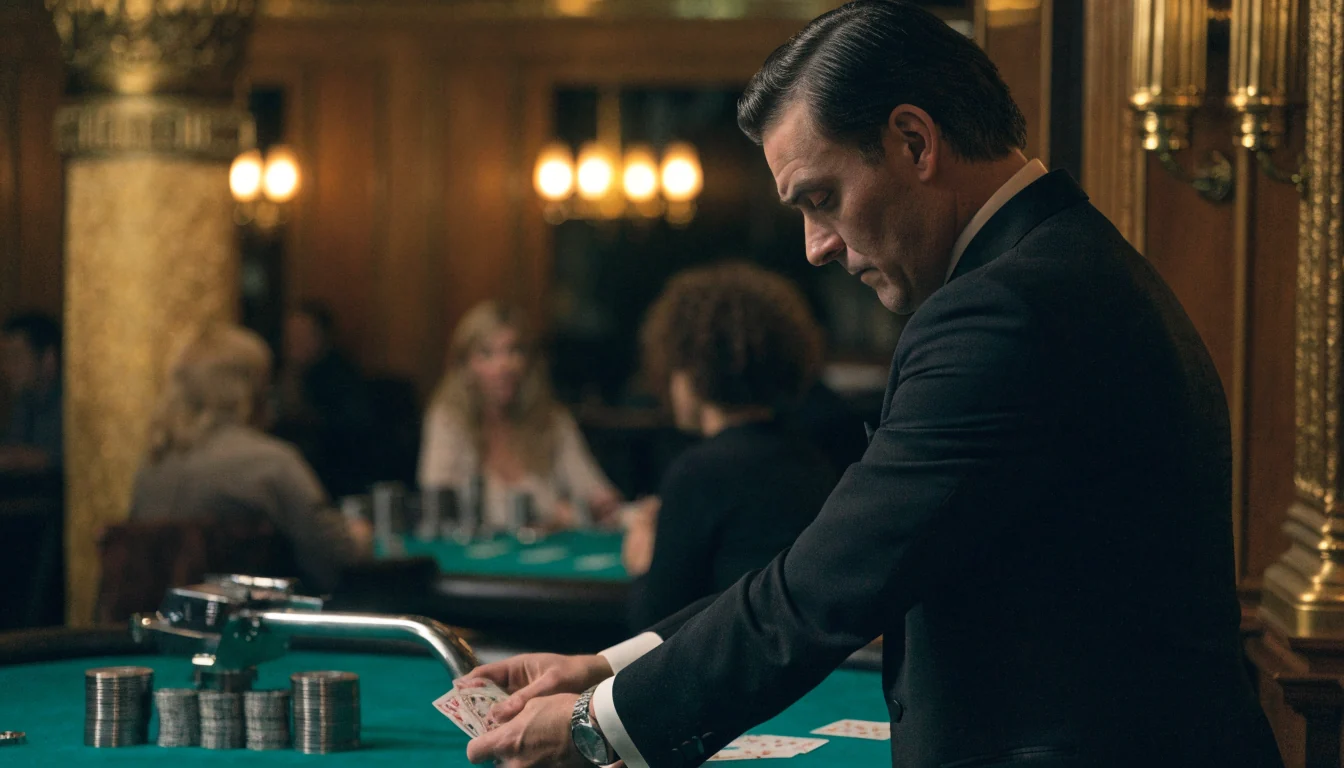
The defining difference at a live blackjack table is not a more lifelike animation. A human dealer handles physical cards from a standard deck, while a camera carries the table to the screen. The cards are real objects, dealt in a studio; the online interface is how players take part and follow what is happening.
That combination changes the texture of the game. In software-only blackjack, the cards and dealer are generated on screen. In a live dealer game, the dealer’s movements and the cards are visible as events at a real table. The visual detail comes from the physical setup, rather than from an animation designed to imitate one. It is still an online game, but the central action takes place in front of a camera.
I find that distinction easy to underestimate when comparing screenshots. A polished digital dealer can look convincing, yet the experience is not the same as watching a person handle cards in real time. The live version gives the table a human presence; it does not make the player physically present in the studio. The screen remains the boundary.
A dealer, not a scripted character
A live dealer is part of the table experience, not just a visual element. Some games provide chat, allowing communication with the dealer and other players. That can make a session feel more social than playing against a software interface alone. It also remains optional: the core activity does not depend on conversation, and a quiet session is still possible.
Chat should not be mistaken for private contact or a way to influence the dealing. It is a table feature. The dealer manages the game, while players communicate through the available interface. The difference is modest but meaningful: the interaction is attached to a shared table, rather than to a character responding inside a standalone game.
The dealer’s presence can also make the pace of events feel more visible, because actions happen in front of the camera. That is an experiential distinction, not a promise of extra control. A player remains a remote participant. Human handling does not turn a casino game into a personal service.
Side bets and Bet Behind
Some live blackjack tables offer side bets alongside the main game. These are separate wagering options presented at the table; their presence does not change what the dealer is doing with the physical cards. They can add another decision to the interface, but they are not required for participation. The table’s own information is the place to establish what a side bet covers before it is used.
A further feature may be Bet Behind. This allows a player to place a wager behind another player’s seat, rather than occupying the main playing position. The distinction is about where the wager is attached at the table. It does not mean taking over the other player’s decisions or directing the dealer.
These features can make a live dealer blackjack casino feel less like a solitary software game, but they should not be confused with better odds or greater influence. A human dealer, chat window, side bet and Bet Behind option each change a different part of the experience. None changes the basic fact that money is at risk.
I have seen table features treated as decoration in promotional copy. That misses their practical effect: chat changes the social atmosphere; side bets add choices; Bet Behind offers another way to join a seat already in use. Small distinctions. Worth noticing.
A live blackjack table is entertainment, not gambling advice. Setting a budget before play remains a sensible boundary, whatever the table looks or feels like.

Blackjack Games: The Table Details That Change the Experience
A live blackjack table can look similar to a digital one on the screen, but it does not run at the same pace. In a software-only game, the next round can begin quickly after a decision. Live play depends on a real-time stream and the table’s shared rhythm, so decisions and transitions take longer. That changes how much of a session is spent waiting between hands.
I have found that pace is not just a matter of patience. It affects how a session feels and how quickly decisions accumulate. A slower round gives more time between bets, but it does not make the game safer or alter its outcome. The practical difference is simply that a live blackjack game is less suited to someone expecting the rapid sequence of a digital version.
The stream also makes connection quality part of the table choice. Live games require a stable internet connection; a weak or interrupted one can make the experience difficult to follow. This is not a special feature of one particular table. It follows from the format: the game is being shown in real time, rather than generated entirely on the player’s device. A connection that handles other online activity inconsistently may not be reliable enough for a live session.
Starting limits are another distinction between blackjack tables and other live casino games. One specialist review reports that many live roulette and baccarat tables begin at around 20p, while blackjack tables often have higher starting limits. That is a report from a review, not a fixed market-wide rule: limits vary by table and operator, and can change. The useful point is not to assume that a live table will accept the same opening stake as another game.
Pace
Live play depends on a real-time stream and shared rhythm, meaning decisions and transitions take longer than in digital versions.
Connection
Stable internet is required to follow the real-time stream without interruptions or difficulty.
Starting Limits
Minimum bets vary by table and operator; they should be checked before play to ensure they fit a pre-set budget.
That matters because the displayed minimum sets the entry point for each round. A table with a higher minimum may be unsuitable for a small, pre-set session budget, even if its pace and stream are otherwise comfortable. The limit should be checked before play, not inferred from the game category or from another table seen elsewhere.
I treat these conditions as separate checks. Pace determines whether the format fits the intended session; connection determines whether the stream can be followed; the minimum determines whether the table fits the planned spend. None makes a blackjack game inherently better. They describe what taking a seat will require.
There is little value in comparing tables by appearance alone. Two live blackjack games can present the same broad format while differing in the conditions that matter before a hand begins. A table that feels suitable on one of those measures may still be a poor fit on another. The sensible comparison is concrete: how quickly the game moves, whether the connection is dependable, and what the opening limit allows.
No shortcut.
How Blackjack Works—and Why No Staking System Removes the Risk
Blackjack has a simple aim: finish closer to 21 than the dealer without going over. A hand that exceeds 21 loses, while reaching 21 is not, by itself, a guarantee of winning; the dealer’s result still matters. The contest is against the dealer’s hand, not against other people at the table.

That objective is straightforward. The outcome is not. Each hand is a separate decision under uncertainty, and even a sensible choice can be followed by a losing result. I have seen players mistake a run of favourable hands for evidence that they have found a reliable way to win. It is not evidence. A short run says what happened in that session, not what the next hand must produce.
What “beating the dealer” does and does not mean
A winning approach starts with understanding the wager: the player is trying to beat the dealer, not to make every hand pay. Some hands will lose; others may win. The aim cannot be to remove that uncertainty, because the game retains a house edge. Over time, that edge favours the casino, even though individual players can have winning sessions.
This distinction is easy to lose when the game is presented as a test of skill. Decisions matter, but skill does not turn each hand into a certain outcome. Nor does a previous loss make a win due. The cards do not compensate for a bad sequence by correcting the next one.
“Beat the house” is a sales-friendly phrase. The practical meaning is narrower: a player may win a hand or a session, but there is no staking pattern that guarantees a profit. The house edge remains part of the game.
Why staking systems cannot erase the edge
Martingale is a familiar example. After a loss, the player increases the next stake in an attempt to recover the amount lost when a win eventually arrives. The idea looks tidy on paper because it treats that eventual win as if it were assured and affordable. Neither assumption holds.
A losing sequence can continue, and each increase places more money at risk. A player can reach a point where the next stake is no longer manageable or permitted by the table. If the sequence ends before a recovery win, the accumulated losses remain. Even when a win arrives, it does not prove the method changed the odds; it only ends that particular run.
Other staking systems can change how money is distributed across hands, but changing stake size is not the same as changing the game’s underlying edge. The system may make losses arrive in a different pattern. It cannot make the dealer’s result predictable.
That is the limit of a “winning system”. It can set a pattern for bets; it cannot promise a winning outcome. I separate those two things because they are often blurred in casino copy. A plan for staking is not a way to control the cards.
The useful measure is therefore not whether a method sounds disciplined, but whether its losses remain affordable when results go against it. A set budget can define that boundary; chasing losses by raising stakes moves it in the wrong direction. Keep the distinction clear. No guaranteed recovery.
Blackjack Rules: Check the Table Before the First Hand
A familiar name does not tell the whole story. A blackjack table has its own rules and paytable, and those are the terms that govern play there. Checking them before joining is more useful than relying on a general explanation of blackjack: the aim is to beat the dealer with a hand of 21 points or less, but the table’s details shape how a hand is settled.

I have seen players treat the game label as if it were a complete specification. It is not. The rules panel and paytable are part of the game, not optional reading tucked away for formalities. They explain the conditions attached to that particular table. If a rule or payout description is unclear, the sensible point to pause is before placing a bet, not after a hand has begun.
What to inspect
Start with the table’s written rules, then look at the paytable rather than assuming the two screens say the same thing. Check how the game describes outcomes and payouts, and whether the rules shown apply to the table currently open. A page describing blackjack in general may explain the objective, but it cannot replace the terms displayed for an individual game.
The distinction matters because a bet is placed under the conditions of the selected table. Moving between tables without checking their information can mean playing under terms that were never part of the original decision. Familiarity is not confirmation.
The same principle applies when a table has promotional wording or a short summary beside its name. “Standard” is not a substitute for reading the actual rules. Marketing labels are brief; the operative details are in the table information. Read the small print. That is the useful part.
Make the check part of the routine
A practical routine is simple: open the rules, read the paytable, confirm that the displayed information belongs to the chosen table, and only then decide whether to take part. If the rules cannot be found or do not make sense, skipping that table is a reasonable choice. There is no need to infer an answer from the game title.
- Open the table's written rules
- Read the paytable
- Confirm the information belongs to the chosen table
- Set a budget limit before playing
This is also where a budget belongs in the decision. Set a limit before playing and keep to it; understanding a table does not remove the financial risk. No rule summary can turn a wager into a guaranteed return, and no interpretation of the paytable should be treated as a promise of profit.
The terms deserve attention even when the interface looks familiar. In my experience, assumptions tend to arrive faster than careful reading, especially when the game is presented as a routine version of a well-known format. A brief check can prevent confusion about what was being played, though it cannot change the underlying risk.
This content is for entertainment purposes only and is not gambling advice.
How to Play a Live Hand: From the Stream to the Bet
A live hand joins two things: a video feed and a betting interface. The game is streamed in real time from a studio, where a human dealer runs the table. The player watches that feed and uses the controls on screen to place bets. It is not a recording with a result generated after the fact.
The screen may put the live video beside or above the betting area. The exact arrangement depends on the table, but the basic sequence is straightforward: open the table, check that the stream is running, select a stake through the interface and confirm the bet. The interface carries the wager to the live game; the stream shows the table activity as it happens.

There is a practical distinction between watching and participating. A video feed can be open without a bet being placed. A wager must be entered through the controls, and the game’s on-screen status indicates whether the interface has accepted it. If a connection drops or the display appears to stall, the sensible response is to pause and check the game status rather than assume a bet went through. No guesswork.
Live blackjack can feel less immediate than a software-only game because the table is unfolding in real time. The stream and betting controls have to remain in step. A stable internet connection therefore matters: if the picture freezes or the interface lags, it becomes harder to follow what is happening and whether a control has registered. That is a technical condition of the format, not a feature that makes the game more favourable.
Before joining, it helps to know which table is open and what its displayed conditions are. Once seated, the interface is the route for placing the wager; the video is the view of the live table. These roles are easy to confuse when the screen is busy. They are separate.
Some sites may offer a free-play mode. That can show how an interface is arranged, but it does not produce real payouts or winnings. Real-money play involves actual financial risk. I treat a set budget as a boundary, not as a target to use up, and stop when it is reached. Live blackjack is entertainment, not gambling advice.
What “Best” Blackjack Means When Limits and Pace Matter
Choosing a live blackjack casino involves more than the game itself: clear, practical details can help set expectations before you play. This list highlights the payout information available for the operators covered here.
-
Dieselwin
- Payout speed
- 1-3 business days
Dieselwin lists a payout speed of 1–3 business days, a useful detail to consider when planning withdrawals.
-
Chanze
- Payout speed
- 1-3 business days
Chanze lists a payout speed of 1–3 business days, giving players a stated timeframe to keep in mind for payouts.
-
EvoSpin
- Payout speed
- 1-3 business days
EvoSpin lists a payout speed of 1–3 business days, providing a clear expectation for payout timing.
-
SpinFormula
- Payout speed
- 1-3 business days
SpinFormula lists a payout speed of 1–3 business days, which may help players plan around withdrawals.
-
Jetsetspins
- Payout speed
- 1-3 business days
Jetsetspins lists a payout speed of 1–3 business days, offering a stated timeframe for payouts.
-
x3bet
- Payout speed
- 1-3 business days
x3bet lists a payout speed of 1–3 business days, making payout timing one practical point to note.
-
Britsino
- Payout speed
- 1-3 business days
Britsino lists a payout speed of 1–3 business days, giving players a reference point for withdrawal timing.
-
Revery Play
- Payout speed
- 1-3 business days
Revery Play lists a payout speed of 1–3 business days, a useful detail when considering payout expectations.
-
Amunbet
- Payout speed
- 1-3 business days
Amunbet lists a payout speed of 1–3 business days, providing a stated timeframe to consider.
-
Zombillion
- Payout speed
- 1-3 business days
Zombillion lists a payout speed of 1–3 business days, offering a practical reference for payout timing.
“Best” is a poor synonym for “most impressive”. In live blackjack, the more useful question is whether a table’s conditions suit the way a session is meant to run. A polished stream cannot compensate for a pace that feels too slow, a connection that keeps dropping, or a minimum bet that is too high for the planned budget. Fit matters more than presentation.
The first trade-off is speed. Live tables move more slowly than software-only blackjack because the game is being dealt and presented in real time. That can make the session feel more considered, but it also means fewer hands in the same stretch of time. Anyone comparing a live table with a digital one is comparing different rhythms, not simply two interfaces for identical play. A faster pace is not automatically better; it can mean decisions and spending accumulate more quickly.
I have seen “non-stop action” used as praise. In practice, a pause between hands is part of the format, not a fault that a slick interface can remove. The right pace is the one that leaves room to follow the session without feeling hurried or frustrated. If the slower rhythm is unwelcome, a live table may not be the best match, however convincing the studio looks.
Do
- Match table conditions to your session boundaries
- Check the displayed minimum bet against your budget
- Ensure your internet connection is stable
Don't
- Assume a polished stream means the pace is fast
- Rely on promotional labels like "premium" or "immersive"
- Stretch your budget to fit a table's minimum bet
Connection quality is another condition, not a technical footnote. Live play depends on a stable internet connection because the game is streamed as it happens. An unreliable connection can interrupt the view of the table or make the timing of participation difficult. A digital game may be less demanding in this respect, but the live format cannot be assessed separately from the network carrying it. A table that suits a home connection may be a poor choice while travelling or using an inconsistent signal.
Minimum bets can be the deciding factor. Live blackjack tables often begin at higher stakes than a casual player expects from other live casino games. A specialist review has cited live roulette and baccarat tables beginning at around 20p while describing blackjack as having higher entry limits; that is a reported comparison, not a dependable current price guide. Table limits can change, so a single review should not be treated as a promise about what is available now. The displayed minimum at the particular table is what matters.

That difference affects the meaning of “best”. A table with a low-looking entry point is not necessarily suitable if the pace, connection demands or other conditions do not fit. Equally, a higher starting limit can rule out a table before its stream or atmosphere becomes relevant. The practical order is simple: establish the amount that can be set aside, check whether the table’s minimum fits within it, then consider whether the pace and connection are workable. If those conditions do not line up, the table is not a good fit.
Promotional language tends to make choice sound like a matter of atmosphere: premium, immersive, exclusive. Those labels describe positioning, not whether the session will suit a particular budget or tolerance for waiting. I have found the unglamorous details more useful. How quickly does the table move? Does the connection remain steady? Is the starting stake affordable without changing the planned budget? Those questions have direct answers at the point of choice. A slogan does not.
There is no universal winner that can be named from these trade-offs alone. The same table may feel measured to one player and tedious to another; its minimum may be manageable for one budget and unsuitable for the next. A sound comparison is therefore less about ranking casinos and more about matching actual table conditions to a session’s boundaries. The best online blackjack setting is the one that does not require those boundaries to be stretched.
That is also why a session budget should be set in advance and kept intact. A table’s pace or atmosphere does not change the financial risk, and a higher starting limit should not prompt an increase in the amount set aside. If the minimum does not fit, moving to another table or leaving live play aside is a more honest response than redefining the budget mid-session.
This is entertainment, not gambling advice. A good fit can make the format easier to understand and manage; it cannot make gambling a reliable way to earn money. Fit first.
Blackjack Casino Sites: Check the Licence Before the Interface
A polished lobby can make a blackjack casino look established before anything meaningful has been checked. In the UK, the first test is more basic: a live dealer casino offering gambling to British customers must hold a licence from the UK Gambling Commission. Without that licence, the site does not meet the legal condition for serving the market.
That is why I treat the licence as a threshold, not a badge of quality. It establishes that the operator is within the UK regulatory system; it does not, by itself, tell anyone whether a particular table, interface or customer service experience will be good. Those are separate questions. Legitimacy comes first.
What the licence tells the market
The Gambling Act 2005 is the main framework for gambling in England, Wales and Scotland. For remote gambling, the practical point is that an operator selling into the British market needs the relevant Gambling Commission licence, even if the business is based elsewhere. A studio’s location does not replace the operator’s licensing obligation.
Live dealer casinos are legal in the UK when they hold that licence. This condition applies to the operator offering the gambling service, not simply to the software or live stream displayed on a site. A familiar-looking interface, a professional dealer or a named payment option cannot stand in for the operator’s regulatory status.

I have seen how easily presentation can become a proxy for trust. Brand language, polished graphics and a wide game lobby are designed to reduce hesitation. They may help explain what a business offers, but they do not answer the central legal question. The licence does.
Check the business behind the page
The name shown in a header may be a trading name rather than the legal entity responsible for the service. That distinction matters when checking a site: the operator named in its terms and account information should make sense alongside the licence information it presents. If the relationship between the brand and the licensed business is unclear, the interface has not resolved the issue.
A sound assessment starts with the operator’s UK Gambling Commission status and whether it covers the service being offered to British customers. The test is not whether a site mentions regulation somewhere in its footer. It is whether the business actually holds the required UK licence. A general reference to “international regulation” is not an answer to that UK-specific question.
The wording can be easy to skim past. “Licensed” may sound conclusive, but the important details are who holds the licence and whether it is the relevant one for the service. An offshore authorisation alone does not meet the requirement for an operator serving the British market. Location is not a workaround.
Licence first, then compare the experience
Once the legal threshold is satisfied, the rest of the evaluation can begin. That is where interface design, table availability, pace and starting limits become relevant; none of those features turns an unlicensed operator into a lawful UK casino. A comparison that starts with attractive screens and leaves licensing until the end puts the least important signal first.
The phrase “best blackjack casino site” is therefore incomplete unless “best” includes the condition that the operator is authorised to serve the market. A site can look convenient and still fail that basic test. Conversely, a licence does not promise that every feature will suit every player. It sets a boundary around who can lawfully provide the service.
For the same reason, an operator ranking should not be read as a substitute for checking the underlying status. Rankings can compare features, but legitimacy is not a preference score. It is a condition of legal operation.
Keep the checks distinct
Licence status answers one question: whether the operator meets the UK requirement to offer online gambling to British customers. It does not settle every question about a session, nor does it make gambling risk-free. Blackjack remains gambling, and a regulated setting should not be mistaken for a guarantee of a particular outcome.
Operators must also verify a customer’s age before allowing deposits into a gambling account. Online gambling in the UK is legal for adults aged 18 and over when the operator holds the appropriate Gambling Commission licence. These are connected safeguards, but they are not interchangeable: age verification does not replace operator licensing, and a licence does not remove the age condition.
A responsible site assessment also keeps practical decisions separate from legal status. A budget should be set before play and kept to; a licence is not a reason to increase it. This is entertainment, not gambling advice.
The clean order is simple: establish that the operator is licensed for the British market, then judge the experience on its own merits. An interface can be persuasive. A licence is the starting condition.
Blackjack Bonuses: The Wagering Terms Behind the Offer
A “blackjack bonus” can sound as though the credit is ready to use at a live table. The promotion’s label is not the operative detail. The terms decide which games qualify, how play counts towards wagering requirements and whether a particular offer can be used at all.
Live blackjack may receive only a small weighting. If a game has a 10% weighting, only a small part of qualifying stakes counts towards the requirement; the rest does not move it forward. That distinction is easy to miss when an offer is presented as a single balance or a simple welcome benefit. The number that matters is not just the wagering requirement, but the game weighting attached to blackjack.
A specialist review of UK welcome offers describes a common pattern: free spins are often aimed at slot games, and those spins cannot be used at live tables. That is a description of offers covered by the review, not a rule that applies to every operator or promotion. A live-table exclusion can sit in the terms even when the headline copy sounds broad.
The same applies to a no-deposit promotion. The wording alone does not confirm that live blackjack is eligible, nor that its contribution is the same as a slot game’s. Some offers may exclude live casino games; others may allow them with reduced weighting. The terms settle the point.
I have seen the headline offer do the selling and the game-contribution table do the limiting. Read both before opting in: wagering requirements, blackjack weighting and any maximum-bet condition can change what the offer is worth in practice. If the conditions are unclear, treating the bonus as available for live play is a poor assumption. Fine print matters.
“Blackjack casino bonus UK” and similar labels are useful shorthand, not a promise of usable live-table funds. A casino blackjack bonus offer may be designed for another part of the site, and a bonus balance can have restrictions that cash funds do not. Check how the operator distinguishes them and what happens if a game is excluded.
Set a budget before playing, and do not treat promotional credit as a reason to extend it. This material is for entertainment purposes only, not gambling advice.
Why does the dealer always win in blackjack?
The dealer does not always win: the aim is to beat the dealer with a hand totaling 21 or less. Blackjack still has a house edge, so players can lose over time.
How do you play live roulette?
Choose a number or other available bet through the on-screen interface, then the dealer spins a physical wheel. You win if the ball lands on a number you selected.
How does the house edge change between games?
It varies by game and bet. In roulette, straight-up bets have a 2.9% house edge, while other bets have a 2.7% edge; in French Roulette, an even-money bet loses only half when the ball lands on zero.
How can you win live dealer roulette?
You win when the ball lands on a number you selected, or when the result matches another bet you placed. American Roulette has 38 pockets and European Roulette has 37, so the odds differ.
Games: UK Casino Game and Slot Guides
Content created by the «Bentelbrothers.com» team